Noria Corporation    Forums  Hop To Forum Categories  Lubrication  Hop To Forums  Car and Truck Lubrication    Are Viscosity Index Improver Polymers all that bad?
Go
New
Find
Notify
Tools
Reply
  
Are Viscosity Index Improver Polymers all that bad?
 Login/Join
 
Level 4 - 251 to 500 posts
Posted
Take three oils of the same 100C viscosity, say a 10w40 and a 15w40 and straight weight 40. The 10w40 will have more viscosity index improver polymers (VIIPs) than the 15w40 because the 15w40 starts with a somewhat thicker base oil. And the straight weight 40 will have no VIIPs. Now we know the VIIPs do not provide lubrication, but expand to maintain oil thickness at higher temperatures. What happens as we increase oil temperature above 100C?

I suspect that as oil temperature exceeds 100C (where all three of our "for example" oils are the same viscosity) that the 10w40 will remain thickest and the straight weight 40 will be the thinnest. Why? Because the VIPPs apparently are better at resisting thinning due to heat (after all they are designed for that purpose) than the oil.

After having said all that, it all seems pretty obvious, but I feel it might be worth some discussion. I recently switched from a 10w40 to a 15w40 that actually is rated about 0.5 cSt higher 100C viscosity than the 10w40. I expected my oil pressure to run a tad higher, but was suprised to find it actually ran a bit lower. The 15w40 (as compared to the 10w40) drops from its cold pressure sooner, stabilizes at the same 2000 rpm pressure (if not a tad lower), and hot runs 2 to 4 psi lower at idle. At first I thought maybe the SJ rated 15w40 I put in had deteriorated, but now I realize that, having less VIIPs, the 15w40 does not take high heat as well. So maybe minimizing VIIPS is not the best goal and I might be better off with the 10w40.

The next lesson I take from this is that my engine must be running oil pressure well above 100C, which may not be good. Anybody know what the oil temp should be? I don't have a temperature gauge, but at 100C this 15w40 should be showing slightly more pressure. The engine does have deposits in it and maybe an Auto-Rx treatment is in order.

This message has been edited. Last edited by: TallPaul,
 
Posts: 358 | Location: Detroit, Michigan | Registered: Thu January 08 2004Reply With QuoteReport This Post
Level 3 - 101 to 250 posts
Posted Hide Post
Thoughts: Your 10W40 was thickening? Your 10W40 had better basestocks?


There are a number of different VIIP's which radically complicates the entire discussion...as does the avalibility of different base oils. That is, a Group II 15W40 such as Longlife which also uses a fairly advanced VII product will probably show better viscosity retention above 100c than a less sophisticated oil. As I recall, you're comparing to a high mileage blend, so the base stocks (and non-VII adds are radically different).

I can't speak to the Valvoline 15W40...it definitely isn't one of the more standard 15W40's and I have no clue what specs it meets. The more well known 15W40's definitely handle heat better than their dino 10W40 counterparts.

Finally, where is the oil pressure sending unit located? At the end of a gallery? Before or after the oil filter?
 
Posts: 103 | Registered: Tue February 10 2004Reply With QuoteReport This Post
Level 4 - 251 to 500 posts
Posted Hide Post
Abus, Your comments pertain to my personal example. My first two paragraphs are open to further discussion on an "all else equal basis." As for my personal example:

I ran a Valvoline 10w40 Maxlife high mileage 10w40 rated SL and now am running the SJ Valvoline Durablend 15w40 (a PCEO). The Durablend has more synthetic than the Maxlife and a different type, and the MSDS's indicate the remainder on both oils is Group I, but am not totally sure on that. The 10w40 held its viscosity per a 3000 mile UOA and over 4000 miles did not really deviate significantly from the typical oil pressures. The Oil pressure sender appears to be shortly after the oil filter and so should not be affected by filter brand. I will note I had a Wix on during the 10w40 and now have a (likely freer flowing) Fleetguard on with the 15w40. I am not really worried and the truck runs fine and I am sure will continue to. Just curious more or less. Actually am more interested in the generic example of my first two paragraphs. Thanks
 
Posts: 358 | Location: Detroit, Michigan | Registered: Thu January 08 2004Reply With QuoteReport This Post
Level 1 - 1 to 50 posts
Posted Hide Post
You are comparing a 10 and 15 w40 oil right? They are thin and thick 40wts. The difference is at 150 deg C. You are probably correct that the vii's effect is more noticible as temps increase, but at some point they should breakdown thermally. As you know vii's don't lube so if they are stiil good but the oil is turning to gas, can they still thicken it up? Perhaps best to have real all be it thin oil the 40wt. mono in high temps, when vapor finds a condensibally cold surface will turn back to oil, the thin base will do the same but may not carry along the needed vii's in the vapor, and not be thick enough as a result.
 
Posts: 8 | Registered: Tue December 15 2009Reply With QuoteReport This Post
Level 3 - 101 to 250 posts
Posted Hide Post
You guys are working with typical numbers for the oil viscosities. The J-300 specs are wide enough that you could easily see the sort of apparent anomalies noted in this string for products that are on-spec.

Just as today's weather is not the climate and today's lunch is not my diet, the typical inspection numbers provided on product data sheets are an average that may bear only passing resemblance to the properties of the quarts you bought from Manny, Moe & Jack.


All of the lies you've heard about me are true
 
Posts: 194 | Location: The Swamps of Jersey | Registered: Fri May 09 2008Reply With QuoteReport This Post
Level 1 - 1 to 50 posts
Posted Hide Post
SmileTPaul:
Stay with your rationale as exposed along your first 2 paragraphs. Paradoxically, the purported advantage of multigrades easing cold starts is even more real at the higher than 100C temperature range! You can easilly see this in a log-log chart of viscosity and temperature, as you extrapolate the straight line trend further into the high temperatures.
Cheers,
Miguel
 
Posts: 4 | Location: US | Registered: Mon December 28 2009Reply With QuoteReport This Post
Level 1 - 1 to 50 posts
Posted Hide Post
quote:
Originally posted by Miguel Azevedo:
SmileTPaul:
Stay with your rationale as exposed along your first 2 paragraphs. Paradoxically, the purported advantage of multigrades easing cold starts is even more real at the higher than 100C temperature range! You can easilly see this in a log-log chart of viscosity and temperature, as you extrapolate the straight line trend further into the high temperatures.
Cheers,
Miguel

PS: the text above needs correction. What I wanted to say was "associated to ease of cold starting, multigrades surpass monogrades in viscosity above 100C" . And viscosity -all things equal - is what separates metal from metal.
 
Posts: 4 | Location: US | Registered: Mon December 28 2009Reply With QuoteReport This Post
Level 1 - 1 to 50 posts
Posted Hide Post
1. Consider your comparison of oil pressure and performance to be directly related, they simply is not necessarily the case. The oil pressure reading is directly related to the resistance that the oil pump experiences to work; a higher viscosity oil at the temperature that the oil pump is working in (80oC say) will normally give a higher pressure reading. It doesn't mean oil flow, just resistance to it. So your multi-grade may in fact be 'lighter' at the temperature of the oil at the oil pump, where the oil pressure sensors operate and then are converted onto the gauge that you see, giving you belief that oil pressure is lower, well in fact the oil flow may be better....

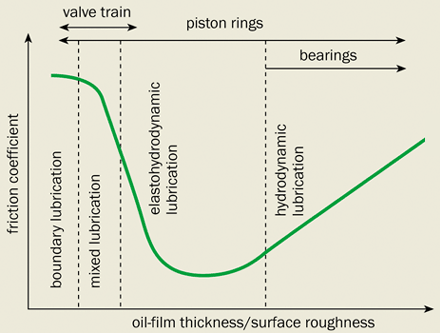
2. And what we don't get involved with, where we should, is the pressure/temperature co-eff. We look at viscoity under Full-film considerations, i.e. co-eff of viscoity for temperature, not the much more important EHL co-eff. which includes both temperature and pressure, important for ring areas, valve-train, etc. So looking at viscosity/temp charts all looks good, but what we need is the overlying pressure factors that really show how good the oil is at maintaining its composure (i.e. viscoity) when we load it up with something a little bit more weighted than 1G.
 
Posts: 15 | Location: Brisbane, Australia | Registered: Wed September 17 2008Reply With QuoteReport This Post
Level 3 - 101 to 250 posts
Posted Hide Post
John, EHL is full-film (elasto-hydrodynamic lubrication). Specifically, the type of film formed in a journal bearing where the shaft floats on a cushion of oil. Ring-to-cylinder, valve train and similar applications with the possibility of metal-to-metal contact are examples of boundary lubrication.

That said - there are too many variables here to make direct correlations. At a given flow rate, you can have a high oil pressure while using a low-viscosity oi because of a restriction or you can have high oil pressure with no restriction with a higher viscosity oil.

The first step in figuring out what data means is figuring out what it DOESN'T mean. Sometimes "I don't know" is the smartest answer.


All of the lies you've heard about me are true
 
Posts: 194 | Location: The Swamps of Jersey | Registered: Fri May 09 2008Reply With QuoteReport This Post
Level 1 - 1 to 50 posts
Posted Hide Post
Again we simplify things by looking at Vis-Temp curves (hydrodynamic regimes), what is much more important is the same oil under extreme loads, please refer to the attachment from the SAE. EHL (or EHD) is more poignant with Vis-Temp-Pressure, not just Vis-Temp. We're talking about non-Newtonian fluids, and pressures do play such an important role. This very important attribute is not easily found, if ever, on a Technical Data Sheet.....

ImageEHL_1.gif (61 KB, 382 downloads) EHL
 
Posts: 15 | Location: Brisbane, Australia | Registered: Wed September 17 2008Reply With QuoteReport This Post
Level 1 - 1 to 50 posts
Posted Hide Post
The SAE Viscosity grade that you have to use is to be taken from the engine manual. The engine manufacturer knows what thickness of oil is to be used. Further, the Viscosity Grade is also dependent on the ambient temperatures, the lowest and the highest. See the following:

http://www.synlube.com/viscosit.htm#Which SAE rating is the best


v.s.s.sarma, Dubai.
 
Posts: 9 | Location: dubai | Registered: Sat June 18 2005Reply With QuoteReport This Post
Level 5 - 501 to 1000 posts
Posted Hide Post
quote:
Originally posted by vsssarma:
The SAE Viscosity grade that you have to use is to be taken from the engine manual. The engine manufacturer knows what thickness of oil is to be used. Further, the Viscosity Grade is also dependent on the ambient temperatures, the lowest and the highest. See the following:

http://www.synlube.com/viscosit.htm#Which SAE rating is the best


Another plug for Swil-lube?

AD


US Navy. Helping keep us safe.
 
Posts: 609 | Location: WA | Registered: Sat May 02 2009Reply With QuoteReport This Post
Level 5 - 501 to 1000 posts
Posted Hide Post
quote:
Originally posted by vsssarma:
The SAE Viscosity grade that you have to use is to be taken from the engine manual. The engine manufacturer knows what thickness of oil is to be used. Further, the Viscosity Grade is also dependent on the ambient temperatures, the lowest and the highest. See the following:

http://www.synlube.com/viscosit.htm#Which SAE rating is the best


That list is a load of something a bull does without a toilet.

And of course, it touts its own oil.

0w-60 the most expensive? Really? Castrol TWS 10w-60 is IIRC about $11-$12/qt at a BMW dealer. 1/3 the price of synlube, and a proven oil to boot.

The best? I'd use M1 5w-50. Both API and ACEA rated, unlike the swill lube.

This message has been edited. Last edited by: Trajan,


Anecdotes are useful for stories and tall tales. To make decisions you need data.
 
Posts: 784 | Registered: Sun March 14 2010Reply With QuoteReport This Post
Level 3 - 101 to 250 posts
Posted Hide Post
In the US, manufacturer's recommendations are intended to optimize engine life versus CAFE. They will recommend the lowest possible viscosity in order to reduce internal friction losses, raising fuel economy by hundreths of a mile per gallon. You'll never notice the fuel savings on an individual level, but it helps the manufacturers the fleet level.

You're worried about your car, they're worried about their continued ability to sell SUVs with their own zip codes to suburban soccer moms.

Whatever the manufacturer recommends, I typically go up one grade to get into the comfort zone and away from the edge of the cliff.


All of the lies you've heard about me are true
 
Posts: 194 | Location: The Swamps of Jersey | Registered: Fri May 09 2008Reply With QuoteReport This Post
Level 3 - 101 to 250 posts
Posted Hide Post
But but but, it says NASA!!!!!!!!
 
Posts: 225 | Location: Maryland | Registered: Mon November 13 2006Reply With QuoteReport This Post
Level 5 - 501 to 1000 posts
Posted Hide Post
quote:
Originally posted by RobertC:
But but but, it says NASA!!!!!!!!
Big Grin

This message has been edited. Last edited by: Trajan,


Anecdotes are useful for stories and tall tales. To make decisions you need data.
 
Posts: 784 | Registered: Sun March 14 2010Reply With QuoteReport This Post
Level 1 - 1 to 50 posts
Posted Hide Post
I don't know if this is right but if ever some aftermarket truck parts or aftermarket car parts can be a key here in order to make things good? I'm not sure about that one but by reading this one, i know that things would have been good and well in the long run.

This message has been edited. Last edited by: Armand Jones,
 
Posts: 8 | Location: Oak Grove, Missouri | Registered: Thu July 08 2010Reply With QuoteReport This Post
  Powered by Social Strata  
 

Noria Corporation    Forums  Hop To Forum Categories  Lubrication  Hop To Forums  Car and Truck Lubrication    Are Viscosity Index Improver Polymers all that bad?


Machinery Lubrication | Reliable Plant
Resources: Oil Filter | Motor Oil | Synthetic Oil | Hydraulic Fluid | Hydraulic System Troubleshooting

© Noria Corporation. All Rights Reserved.